
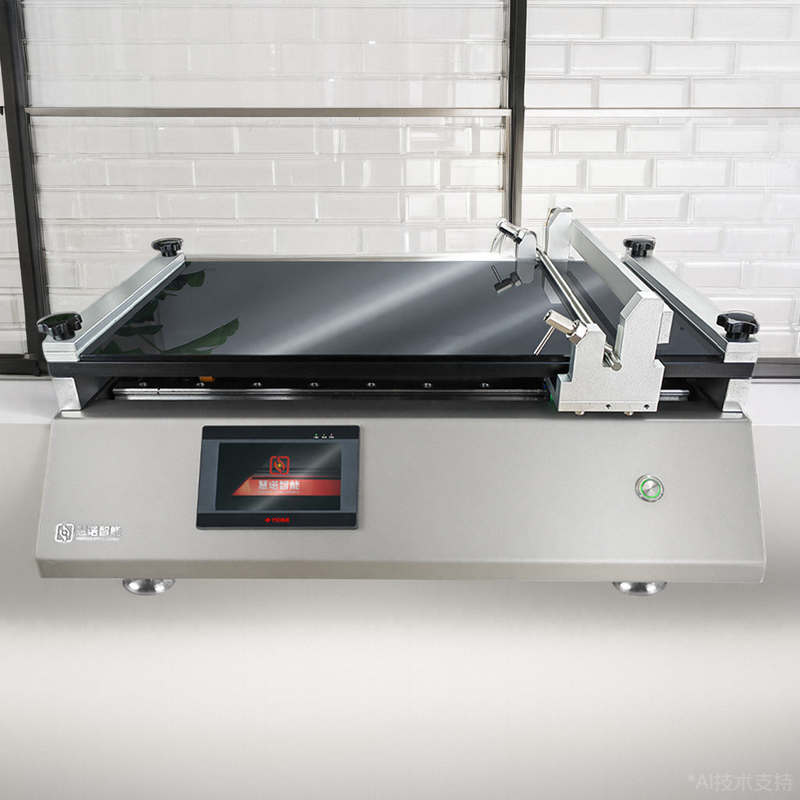
Laboratory Film Applicator is a device used for film coating at laboratory scale. It is widely used in research and development work in materials science, electronic engineering, Optical inspection and other fields. In the classification of Laboratory Film Applicator, it is divided according to factors such as coating method, substrate size, coating material, etc. Each type has its unique technical principles and applicable scenarios. This article will analyze the classification of Laboratory Film Applicator and its technical principles in detail.
The spin coating method is one of the most common methods in laboratory film. The principle is to drop the coating on the swirl/spin substrate and uniformly coat the liquid on the surface of the substrate through centrifugal force. This method is suitable for the case of uniform and thin film preparation, and is often used in the preparation of Optical inspection films, film Electrode, etc.
The spin coating machine is mainly composed of a swirl/spin table, a coating liquid injection system, a Control system, etc. During operation, the substrate is first fixed on the swirl/spin table, and then the swirl/spin speed and time are set through the Control system, and then the coating droplets are placed in the center of the substrate. After the swirl/spin starts, the liquid will be evenly coated on the surface of the substrate and a thin film will be formed after the swirl/spin is completed.
The lame plating method is a coating method that forms a thin film by spraying the Coating solution on the surface of the substrate through Nozzle. Compared with the spin coating method, the lame plating method can realize the coating of a larger area, and the lame plating pressure and Nozzle spacing can be adjusted to control the thickness and uniformity of the film.
The lame plating machine is mainly composed of lame plating head, Nozzle, Coating supply system, etc. During operation, the Coating is transported to the Nozzle, and the liquid is sprayed atomization by air pressure, and then sprayed on the surface of the substrate to form a film.
Evaporation deposition is a coating method in which solid materials are heated to their vapor form and then deposited on the surface of the substrate to form a thin film. This method is suitable for preparing high-purity, high-mass films, and is often used for preparing metal films, oxide films, etc.
The evaporation deposition machine is mainly composed of a vacuum chamber, a heating source, a substrate fixture, etc. During operation, the substrate is placed in the vacuum chamber first, and then the heating source heats the material to evaporate and deposit it on the substrate surface.
Film Applicators are suitable for processing smaller size substrates and are typically used for laboratory-scale research and development work. This type of Film Applicator has a smaller footprint and lower cost, making it suitable for experiments that do not require high substrate size.
Medium-sized substrates Film Applicators are suitable for processing medium-sized substrates and can meet certain scale production needs. This type of Film Applicator typically has higher coating speeds and greater substrate processing capabilities, making it suitable for small and medium-sized production and R & D work.
Film Applicators are suitable for processing large-size substrates and are typically used in large-scale production and industrial applications. This type of Film Applicator has a larger coating area and higher production efficiency, enabling it to meet the needs of large-scale production.
Organic matter coaters are suitable for coating organic materials, such as polymers, organic small molecules, etc. This type of Film Applicator usually has high coating accuracy and a wide range of coating materials, suitable for preparing organic electronic devices, organic optoelectronic materials, etc.
Inorganic matter coaters are suitable for coating inorganic materials such as metals, oxides, silicon, etc. This type of Film Applicator usually has high coating temperature and Vacuum Level requirements, and is suitable for preparatory Optical inspection films, metal films, etc.
Multifunctional coaters have the ability to coat a variety of materials to meet the coating needs of different materials. This type of Film Applicator is usually highly flexible and versatile, suitable for research and development of a variety of materials.
Laboratory Film Applicators play a crucial role in the fields of materials science, electronic engineering, Optical inspection, etc. Different types of Film Applicators have their own unique characteristics and application scenarios. By in-depth understanding of the classification of laboratory Film Applicators and their technical principles, you can better select and apply film equipment suitable for your own research needs, and promote the development of scientific research and technological innovation.

 简体中文
简体中文 Korean