
Colloidal Quantum Dots (CQDs) are a new class of materials that have attracted much attention in the field of nanomaterials in recent years. Due to their unique optoelectronic properties, such as wide absorption Light spectrum, narrow emission Light spectrum, and adjustable luminescence Color, CQDs have shown great application potential in optoelectronic devices, biometric imagery, photocatalysis and other fields. This paper will introduce the preparatory technology of colloidal quantum point films and their applications in different fields in detail.
Colloidal quantum points are usually made of group II-VI or III-V semiconductor materials, such as CdSe, PbS, InP, etc. Its core structure is generally semiconductor nanocrystalline, and the surface is coated with organic ligands to stabilize its suspension in solution. This structure not only ensures the photoelectric properties of quantum points, but also improves their dispersion and Stability in different media.
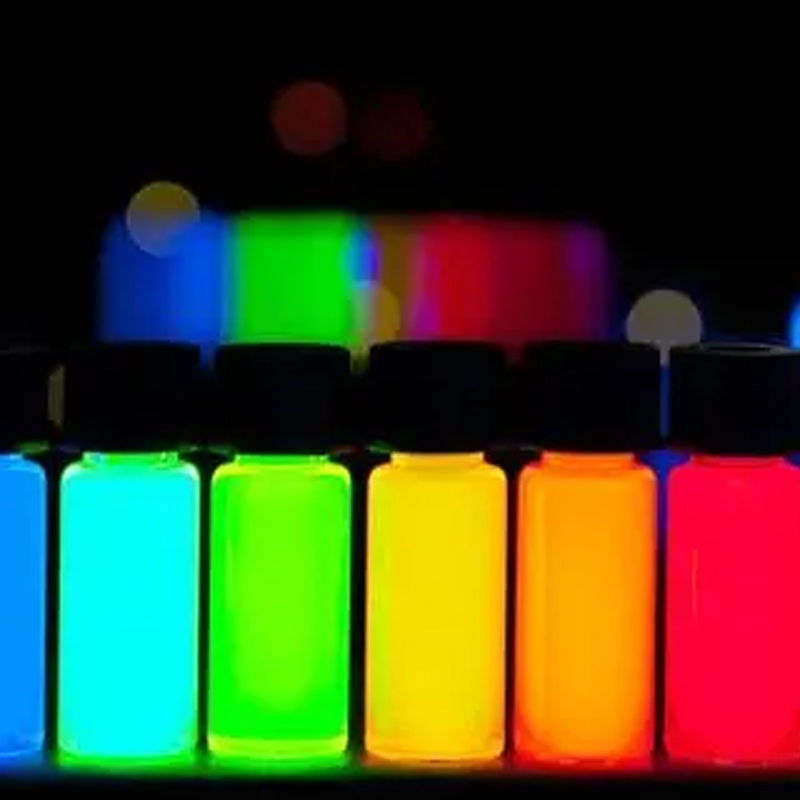
The unique photoelectric properties of CQDs are mainly due to their quantum confinement effect. When the size of semiconductor nanocrystals reaches a certain critical value, the movement of electrons and holes is restricted, resulting in discretization of energy levels, resulting in a series of unique Optical inspection and electrical properties:
Absorption Light spectrum: CQDs have a wide absorption Light spectrum, which can effectively absorb light in the ultraviolet to Near infrared range.
Light spectrum: Color of emission of CQDs is closely related to its size, the smaller the size, the shorter the emission wavelength (blue shift); the larger the size, the longer the emission wavelength (red shift).
Quantum efficiency: High-mass CQDs have a higher quantum yield, that is, a higher photon emission efficiency.
Stability: CQDs have high chemical Stability and thermal stability and are suitable for a variety of harsh environments.
The solution spin coating method is one of the common methods for preparing CQDs films. This method uses centrifugal force to uniformly coat the CQDs solution on the surface of the substrate by dropping the CQDs solution on the swirl/spin substrate.
Operation steps
Solution preparatory: CQDs are dispersed in a suitable solvent to prepare a homogeneous quantum point solution.
Substrate preparation: Select the appropriate substrate, such as Glass, silicon or plastic, and clean it.
Spin coating: The quantum point solution is added dropwise to the substrate in swirl/spin, and the film thickness and uniformity are controlled by adjusting the swirl/spin speed and time.
Drying: After spinning the coating, the substrate is dried at the appropriate temperature to remove the solvent and fix the film.
advantage
Simple and easy to implement, suitable for large-area coating.
Film thickness and uniformity are easy to control.
disadvantage
Smoothness of solution viscosity and substrate surface requirements are high.
Environmental humidity and evaporation rate of solvent may affect film mass.
Dip coating by immersing the substrate in a CQDs solution and slowly pulled out to form a uniform film.
Operation steps
Solution prepative: The same as spin coating method, the preparation of uniform CQDs solution.
Substrate preparation: Select and clean the substrate.
Dip coating: immerse the substrate vertically in the solution and then pull it out at a constant speed to control the film thickness.
Drying: same as spin coating, drying treatment.
advantage
The film thickness is uniform and can be controlled by adjusting the pull-out speed and solution concentration.
Suitable for complex shapes and large area substrates.
lackpoint
The uniformity of the film is greatly affected by the surface tension and viscosity of the solution.
The process speed is relatively slow.
Lame plating by the gas stream CQDs solution atomization and sprayed onto the substrate surface to form a film.
Operation steps
Solution preparatory: Preparative CQDs solution.
Substrate preparation: Select and clean the substrate.
Lame plating: the use of spray gun solution atomization, evenly sprayed to the substrate surface.
Drying: drying treatment.
advantage
It is suitable for coating large areas and complex shapes.
Film thickness can be controlled by adjusting lame plating parameters.
disadvantage
The equipment cost is high and the process parameters are complex.
The film uniformity is influenced by factors such as lame plating speed, air pressure and solution viscosity.
Electrophoresis deposition using an electric field driving charged CQDs deposited on the surface of the substrate to form a film.
Operation steps
Solution Preparative: Preparative suspension of charged CQDs.
Substrate preparation: select and clean the conductive substrate.
Electrophoresis deposition: Electrode substrate, apply an electric field, drive the quantum point deposition.
Drying: drying treatment.
advantage
Film thickness and shape can be precisely controlled.
Suitable for coating conductive substrates and complex shapes.
disadvantage
The equipment costs are high and the operation is complex.
Limited scope of application, only applicable to conductive substrates.
The application of CQDs films in Light Emitting Diodes (LEDs) is one of the current research hotspots. Due to the high quantum efficiency and adjustable luminous Color of CQDs, the luminous efficiency and color mass of LEDs can be significantly improved.
Working Principle
In CQDs-LEDs, CQDs are used as luminescent materials to generate light by injecting charges (electrons and holes). According to the size and composition of the quantum point, the emission wavelength can be adjusted to achieve full-color display.
application example
Display: CQDs-LED displays have a wider color gamut, higher contrast ratio and longer life, and have been gradually used in display devices such as TVs and mobile phones.
Lighting: CQDs white LEDs with high color rendering index (CRI) are suitable for high-quality lighting needs, such as museums, hospitals, etc.
The application of CQDs films in solar cells is mainly reflected in the improvement of their light absorption capacity and energy conversion efficiency. Due to the wide absorption Light spectrum and adjustable energy band structure of CQDs, the photoelectric conversion efficiency of solar cells can be effectively improved.
Working Principle
In CQDs solar cells, CQDs are used as light-absorbing materials to absorb sunlight to generate electron-hole pairs, collect charge through Electrode, and generate current. By optimizing the size and surface modification of quantum points, the open-circuit voltage and short-circuit current of the battery can be increased, thereby improving the photoelectric conversion efficiency.
application example
Thin film solar cells: CQDs thin film solar cells are lightweight, flexible, and suitable for use in Portable power supplies and wearable devices.
Laminated solar cells: CQDs are combined with Miscellaneous materials to form a laminated solar cell, which can further improve the conversion efficiency and be applied to high-efficiency solar power generation.
CQDs films also show a wide range of applications in the field of biological imagery and sensing. Due to their high luminance, Stability and biocompatibility, CQDs can be used for biomarkers and detection.
Working Principle
In biological imagery, CQDs act as fluorescent probes to visualize biological tissues or cells by specifically binding biomolecules to excite luminescence at specific wavelengths. In Sensor, CQDs interact with target molecules and change their Optical inspection properties to achieve detection of target molecules.
application example
Fluorescence imagery: CQDs are used for fluorescence imagery of cells and tissues with high Sensitivity and resolution and have been applied in biomedical research.
Biosensors: CQDs-based Biosensors can be used to detect environmental contaminants, pathogens and biomarkers with high Sensitivity and selectivity, and have been used in environment monitoring and medical diagnostics.
The applications of CQDs films in the field of photocatalysis are mainly reflected in photolysis of water to produce hydrogen and degradation of organic pollutants. Due to the wide absorption Light spectrum and high photogenerated charge separation efficiency of CQDs, the efficiency of photocatalytic reactions can be significantly improved.
Working Principle
During photocatalysis, CQDs absorb photons, generating electron-hole pairs that can participate in oxidation reduction reactions. For example, in the process of photolysis of water to produce hydrogen, photogenerated electrons reduce hydrogen ions in water to produce hydrogen gas, and photogenerated holes generate oxygen in the oxidation water. By optimizing the size, surface modification, and recombination of CQDs with Miscellaneous catalysts, the photocatalytic efficiency can be improved.
application example
Hydrogen production by photolysis of water: CQDs are combined with Miscellaneous photocatalytic materials to prepare efficient photocatalysts for hydrogen production by photolysis of water, which has the advantages of renewable and environmentally friendly.
Pollutant degradation: CQDs-based photocatalysts are used for degradation of organic pollutants in water and air, such as dyestuffs, pesticides, etc., to achieve environmental purification.
In addition to the above main applications, CQDs films also show a wide range of application potential in the field of Miscellaneous.
laser
CQDs have narrow-band emission and high gain characteristics, which can be used as a laser gain medium to prepare efficient and low-threshold quantum point lasers. CQDs lasers have the advantages of adjustable wavelength, small size and low power consumption, and are suitable for optical communication, laser display and other fields.
photovoltaic device
CQDs are used as sensitizers or light absorbing layers in photovoltaic devices to improve the photoelectric conversion efficiency of photovoltaic devices. By compounding with organic materials or inorganic semiconductors, CQDs are prepared for high-efficiency photovoltaic devices, which are used in solar cells, photodetectors, etc.
Quantum point ink
CQDs film technology can also be applied to printing electronics, flexible electronics and other fields. By preparing CQDs into quantum point inks, inkjet printing and other technologies can be used to realize large-area, low-cost electronic device manufacturing, such as flexible displays, Sensors, etc.
Although CQDs films have shown broad application prospects in many fields, they still face some technical challenges in practical applications:
Material toxicity: Some CQDs contain heavy metals (such as Cd, Pb, etc.), there are environmental and biological toxicity problems, and it is necessary to develop non-toxic or low-toxic alternative materials.
Film Uniformity: Stability and uniformity of the film are critical to device performance and require optimization of film processes and material formulations.
Long-term Stability: CQDs in practical applications require long-term chemical and Optical inspection Stability to prevent light attenuation and degradation.
Large-scale production: CQDs film technology needs to be transformed from laboratory to industrial production, including large-scale, high-efficiency preparatory and application technologies.
With the continuous development of materials science, nanotechnology and engineering technology, CQDs film technology will achieve more breakthroughs and applications in the future.
New CQDs materials: Develop non-toxic and environmentally friendly new CQDs materials, such as carbon quantum points, silicon quantum points, etc., to solve the toxicity problem of traditional quantum points.
Efficient film technology: Research and development of efficient and low-cost CQDs film technology, such as inkjet printing, nano printing, etc., to achieve large-area, fine pattern coating.
Multifunctional compositing: Composite CQDs with Other functions materials (such as metal nanoparticles, 2D materials, etc.) to prepare multi-functional, high-performance composites to expand Applications.
Smart devices: Combine CQDs film technology with cutting-edge technologies such as flexible electronics and smart materials to develop new smart devices, such as wearable devices and flexible displays, to promote the application upgrade of CQDs technology.
As an emerging nanomaterial application technology, colloidal quantum point film technology has broad application prospects and huge market potential. By continuously optimizing material performance, improving film process, and expanding Applications, CQDs film technology will play an important role in optoelectronic devices, biological imagery, photocatalysis and other fields. In the future, with the further development and maturity of technology, CQDs film technology will bring more innovation and change to scientific and technological progress and social development.

 简体中文
简体中文 Korean