
Lithium-ion batteries are widely used in fields such as Portable electronic devices, electric vehicles and energy storage systems due to their high energy density, long cycle life and environmental protection characteristics. The performance of lithium batteries largely depends on their components, including anode, cathode, electrolysis liquid and diaphragm. As a physical isolation layer inside the battery, the diaphragm plays the role of separating the positive cathode, preventing electrons from passing directly and allowing ions to pass through. In order to improve the overall performance of lithium batteries, functional coating of diaphragms has become a research hotspot in recent years.
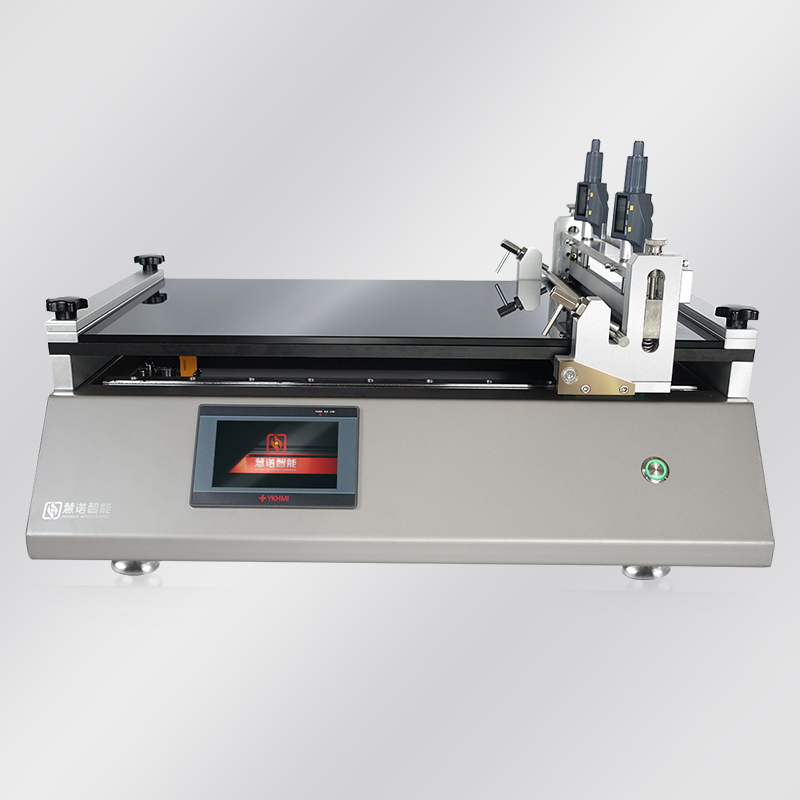
Experimental Film Applicator is a device that can precisely control the coating thickness and uniformity, and is widely used in the coating process of lithium battery separators. This experiment aims to explore the process optimization, coating performance and impact on the overall performance of the battery by using Experimental Film Applicator to coat lithium battery separators.
Substrate: Commercial polyolefin (PP/PE) diaphragm.
Lithium Battery Stocks:
Anode Stock: LiFePO4 is used as the active material, a conductive agent (such as carbon black) and a binder (such as PVDF) are added, and a certain viscosity Stock is prepared.
Cathode Stock: Graphite as active material, adding conductive agent and binder.
Solvent: NMP (N-methylpyrrolidone) and water.
Experimental Film Applicator: Adjustable film speed. Controllable film thickness. Equipped with drying system.
Oven: for drying after film.
Electronic Balance: Used to weigh materials.
Microscope: used to observe coating morphology.
Electrochemistry test system: used to test battery performance.
2.3.1 Coating Preparative
Add the anode material, conductive agent and binder to the solvent in a certain proportion. Mix using a high speed Stirrer until the Stock is homogeneous and particle free. Stock viscosity is measured by Viscometer to ensure it fits the film.
2.3.2 film process
Fix the diaphragm substrate on the bench of the Experimental Film Applicator.
Adjust Film Applicator film speed and film thickness.
Open the Film Applicator and evenly coat the prepared Stock on the surface of the diaphragm.
After the film is completed, the coated diaphragm is placed in a drying system for drying.
2.3.3 drying and post-treatment
The coated and drying diaphragm is removed from the film machine. Microscope is used to observe the uniformity and thickness of the coatings. A series of physical and electrochemistry performance tests are performed on the coatings.
3.1 coating uniformity and thickness control
Uniform and thickness-controllable coatings can be obtained by adjusting the speed and film thickness parameters of the experimental Film Applicator. Microscope observation of the coating shows that the coating surface is smooth and has no obvious defects. By measuring the coatings under different speed and thickness parameters, the optimal film process conditions are determined.
3.2 Physical performance testing of coatings
3.2.1 adhesion testing
The adhesion of the coating was tested by tensile test. The results showed that the coating adhesion obtained by the optimized film process was strong and not easy to flaking.
3.2.2 abrasion resistance testing
Wear resistance tester was used to carry out abrasion resistance testing of the coating. The results show that the coated lithium battery Stock coating has good wear resistance performance and helps to improve the cycle life of the battery.
3.3 electrochemistry performance test
3.3.1 battery assembly
Stock coated diaphragm and cathode material are assembled to form a button battery. Each step of the assembly process is strictly controlled to ensure the conformity of the battery.
3.3.2 Cyclic voltammetry
Cyclic voltammetry was used to test the electrochemistry performance of the coated diaphragm battery. The test results showed that the diaphragm battery coated with Lithium Battery Stock exhibited excellent electrochemistry Stability and low internal resistance during charging and discharging.
3.3.3 Cycle Life Testing
The results show that the separator coated with Lithium Stock can significantly improve the cycle life of the battery, and the coating effectively inhibits the growth of lithium dendrites.
3.4 Effect of different film parameters on battery performance
The effect of different film parameters (such as film thickness and film speed) on battery performance was studied by adjusting different film parameters through the experimental Film Applicator. The results show that appropriately increasing the film thickness can improve the capacity of the battery, but too thick coating will increase the internal resistance of the battery and affect the Power performance of the battery. The film speed has a significant impact on the uniformity of the coating. A lower film speed can obtain a more uniform coating, but it will reduce the production efficiency. Therefore, an optimal equilibrating point needs to be found between the film thickness and the speed.
In this experiment, the influence of different film parameters on the coating performance and the overall performance of the battery was studied by coating the lithium battery Stock on the separator of the lithium battery through the experimental Film Applicator. The experimental results show that the optimized film process can obtain a uniform and controllable thickness coating, which significantly improves the cycle life and electrochemistry performance of the battery.
The film thickness and film speed are the key factors affecting the coating performance and battery performance. Through experimental research, the optimal film process parameters are determined, which provides an important reference for the further optimization of the lithium battery separator coating process. At the same time, this study also proves the feasibility and importance of the experimental Film Applicator in the application of lithium battery separator coating, and has a wide range of application prospects.
Future research can further optimize the formulation of film Stock, explore the application of different types of functional coatings on lithium battery separators, and the practical application effect in industrial production, in order to achieve a comprehensive improvement of lithium battery performance.

 简体中文
简体中文 Korean