
The film coating adhesive technology has been widely used in many industries such as Encasement, Electronics, Medical, etc. This paper discusses the application of an experimental small coater to apply adhesive on the film. Through detailed experimental steps and Data analysis, the influence of its Spreader effect and process parameters on the coating mass is studied. The results show that the experimental small coater can achieve uniform and stable coating mass when controlling parameters such as Spreader speed, Adhesive viscosity and Coat Weight, which provides a reliable experimental basis and practical application reference for film coating adhesive technology.
With the continuous advancement of industrial technology, the application of thin film adhesive technology in various fields is more and more extensive. Thin film materials are widely used in Encasement, electronic component packaging and medical apparatus manufacturing due to their lightweight, high strength and flexibility. The core of Spreader technology lies in how to uniformly and stably coat Adhesive on the surface of the film to achieve the desired adhesion effect and performance. In order to study the influence of Spreader technology process parameters on coating mass, this paper uses an experimental small coater to conduct adhesive coating experiments on thin film materials and analyze the influence of each parameter.
Materials and equipment
Film substrate: polyester (PET) film with a thickness of 50 microns.
Adhesive: Acrylic water-based Adhesive, Solid content 50%.
Experimental small coater: using drawdown blade Spreader head, the maximum application width 300mm, Spreader speed adjustable range 0.1-10 m/min.
Drying equipment: Infrared drying oven, Temperature range 50-150 ℃.
Coating thickness measurement instrument: Laser thickness gauge, Measurement accuracy 0.1 micron.
Clean the film substrate to ensure that the surface is free of dust and grease.
Adhesive solution was prepared and uniformly dispersed by stirring.
Fix the membrane to the conveyor belt of the coater and set the Spreader Speed and Coating Weight.
Start the coater so that the drawdown blade Spreader Adhesive uniform film surface.
Spreader film by infrared drying oven, drying temperature is set to 100 ℃, drying time of 3 minutes.
Coating thickness measurement using laser thickness gauge, Coating thickness data recorded under different process parameters.
Appearance inspection of coatings to evaluate uniformity and smoothness of coatings.
Peel Strength Test to evaluate Adhesive performance.
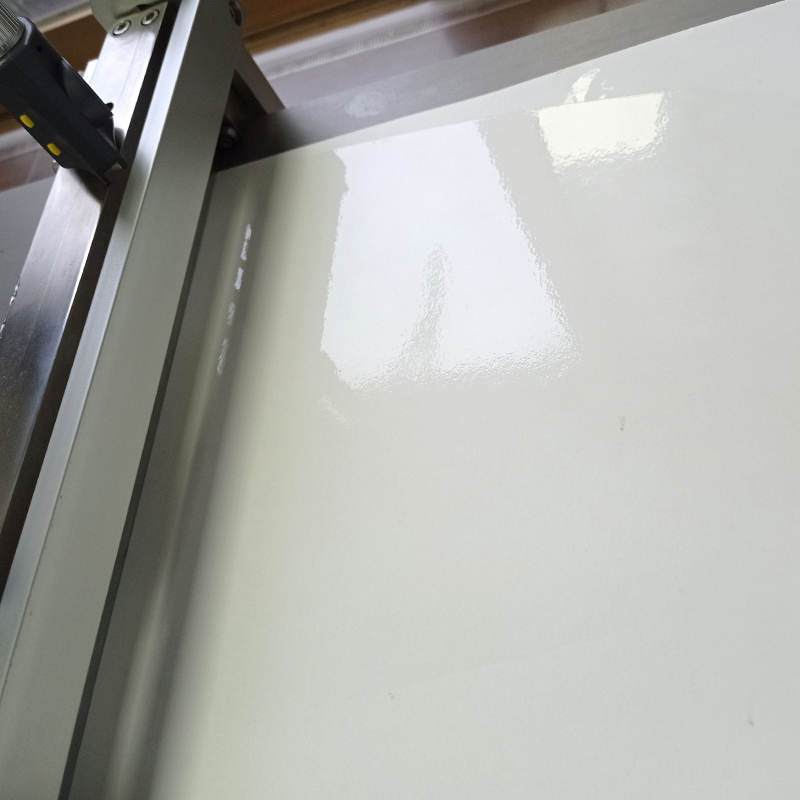
Effect of Spreader Velocity on coating mass
Spreader speeds (0.5m/min, 1.0m/min, 2.0m/min) were experimentally set to maintain Miscellaneous conditions. By measuring Coating thickness and observing coating surface, the results are as follows:
Spreader speed of 0.5m/min: Coating thickness uniform, the average thickness of 10 microns, smooth coating surface without bubbles.
Spreader speed of 1.0m/min: Coating thickness fluctuates slightly, the average thickness is 9.5 microns, a small number of streaks appear on the surface.
Spreader speed of 2.0m/min: Coating thickness fluctuation is large, the average thickness is 9 microns, surface fringes increased significantly.
It can be seen that the Spreader speed has a significant impact on the Coating thickness and uniformity. Lower Spreader speed helps to obtain a uniform and smooth coating, while too high Spreader speed can lead to uneven Coating thickness, streaks and bubbles and other defects.
Effect of Adhesive Viscosity on coating mass
Adhesive viscosity (1000cP, 1500cP, 2000cP) was adjusted, Miscellaneous condition was kept unchanged, and its effect on coating mass was studied.
Adhesive viscosity of 1000cP: Coating thickness is thin, the average thickness of 8 microns, uniform coating but weak adhesion.
Adhesive viscosity of 1500cP: Coating thickness moderate, the average thickness of 10 microns, uniform coating and good adhesion.
Adhesive viscosity of 2000cP: Coating thickness is thick, the average thickness of 12 microns, but the coating surface appears a small amount of bubbles, strong adhesion.
The results show that the viscosity of Adhesive has an important influence on the coating thickness and adhesion performance. Moderate viscosity (1500 cP) can achieve uniform and good adhesion coatings, while too low or too high viscosity will affect the coating mass.
Effect of Coating Weight on coating mass
Coating Weight (0.5g/m ², 1.0g/m ², 1.5g/m ²) was controlled to study its effect on Coating thickness and uniformity.
Coating Weight of 0.5g/m ²: Coating thickness is thin, the average thickness of 8 microns, uniform coating surface but poor coverage.
Coating Weight 1.0g/m ²: Coating thickness moderate, average thickness of 10 microns, uniform coating and good coverage.
Coating Weight 1.5g/m ²: Coating thickness is thicker, the average thickness is 12 microns, uniform coating but longer drying time.
Studies have shown that an increase in the amount of Spreader will lead to an increase in the Coating thickness, but it is also necessary to control it within an appropriate range to ensure the uniformity and coverage of the coating.
The effects of Spreader Velocity, Adhesive Viscosity and Coating Weight on the coating mass were analyzed through the study of small coater coating on film.
A lower Spreader speed helps to achieve a uniform and smooth coating, but too low a speed can reduce production efficiency.
Adhesive viscosity moderate (1500cP) can achieve good coating uniformity and adhesion performance, too high or too low viscosity will affect the coating mass.
Controlling the appropriate Coating Weight (1.0g/m ²) can achieve uniform and good coverage of the coating. Spreader amount is too large or too small will affect the coating effect.
This experiment provides reliable experimental data and process parameters reference for film coating adhesive technology, which is helpful to further optimize the Spreader process and improve the coating mass and production efficiency.

 简体中文
简体中文 Korean